
Irish Red and White Setter
EYE-rish RED and WHITE SET-uhr
Ireland· County Down and rural Ireland
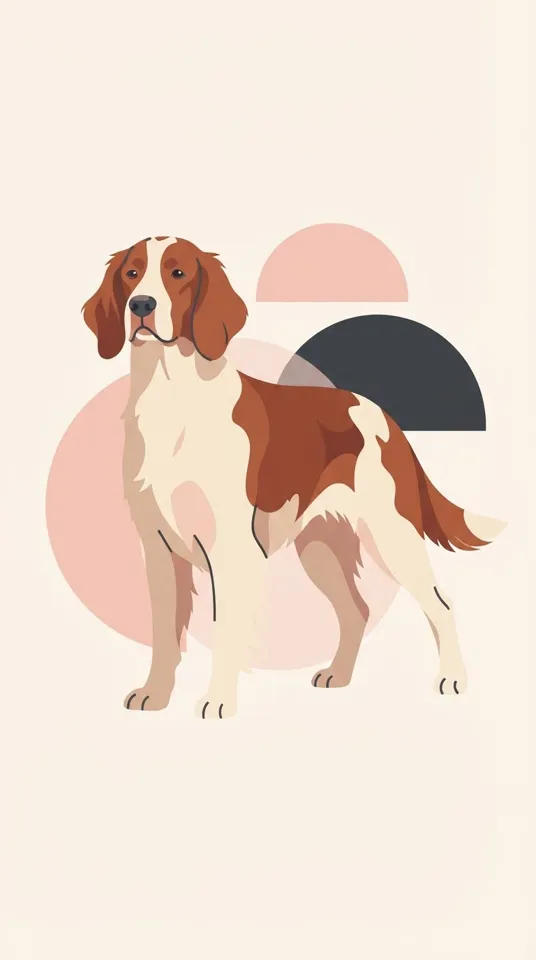
The Irish Red and White Setter is a gundog bred in Ireland to point game across bog and moorland, distinguished from its all-red cousin by its patched red and white coat.
At a glance
Quick facts
- Size
- Large
- Exercise needs
- 90+ minutes daily
- Home size suited to
- Medium to large home
- Grooming frequency
- Twice weekly brush
- Coat length
- Medium
- Sheds
- Yes
- Lifespan
- 11-13 years
- Town or country
- Either, with enough exercise
- Garden size needed
- Medium or larger
Where it comes from
Origins of the Irish Red and White Setter

Working the wet moors and boglands of Ireland, the breed needed stamina and a coat dense enough to shed rain, while its white patches helped hunters spot it at a distance across open ground.
- Region
- County Down and rural Ireland
- Climate it was bred for
- Cool, damp, boggy moorland
- Original job
- Pointing game birds over bog and moorland
The long read
About the breed
The breed predates the solid red Irish Setter and was the more common type in Ireland until the nineteenth century, when breeders favouring a flashier show colour selectively bred it out; the red and white variety nearly disappeared as a result. It survived through the efforts of a small number of Irish estates, notably that of the Reverend Noble Huston in County Down, who kept a dedicated line going through the early twentieth century when few others bothered.
Living with a Red and White Setter means living with a dog that wants a job and a lot of it; the breed retains strong working drive and is happiest with structured exercise such as running, gundog training or long countryside walks rather than a stroll round the block. It is generally easygoing with people and other dogs, less highly strung than some setter lines, and its shorter, less profuse coat than the Irish Setter makes grooming somewhat easier, though regular brushing is still needed to prevent matting behind the ears and legs.
The breed remains considerably rarer than the solid red Irish Setter, both in Ireland and abroad, and buyers typically wait for a litter from one of a small number of dedicated breeders. It suits an active family or a shooting household prepared to give it genuine outdoor work rather than a purely ornamental role.
Living with one
Temperament & needs
Our own ratings, based on the breed standard and how these dogs behave in ordinary homes.
Friendliness
4/5
How openly the Irish Red and White Setter greets people it does not know.
Trainability
4/5
Responsive and eager when given a job to do.
Energy
5/5
A genuine working gundog needing significant daily exercise.
Barking
2/5
Not prone to excessive barking.
Grooming
3/5
Weekly brushing keeps the feathering free of tangles.
Suits a first-time owner
3/5
How forgiving the Irish Red and White Setter is for someone taking on their first dog.
Sociability
4/5
Friendly with people and generally good with other dogs.
Independence
3/5
Can range far when hunting instinct kicks in.
Illustrated breed standard
The points of the breed
Hover or tap a numbered point to read what the standard asks for.
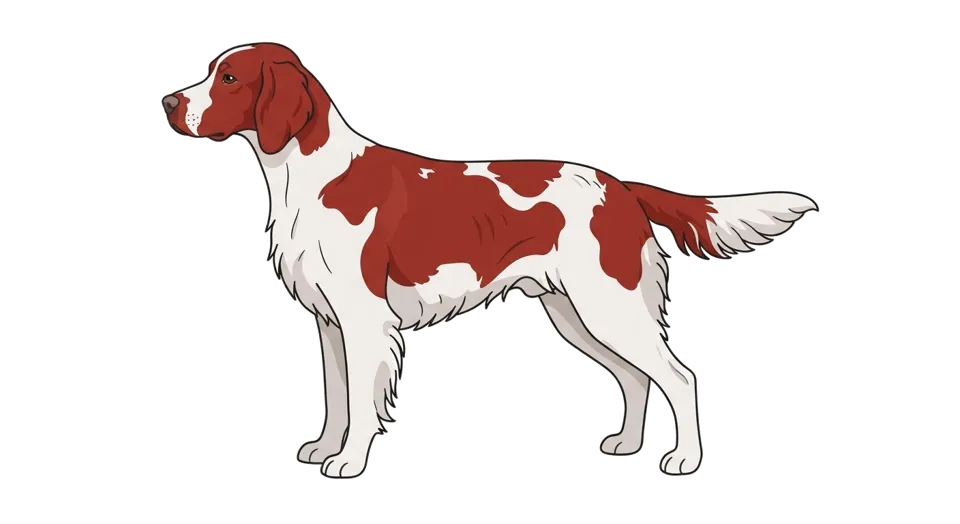
Point 1
Skull
The Irish Red and White Setter's skull is judged on balance rather than size — proportionate to the body, with a clean cheek and a stop typical of the breed. Coarseness or an over-refined head are both faulted.
Colours & patterns
Recognised coats
Which coats the standard accepts — and which are simply popular.
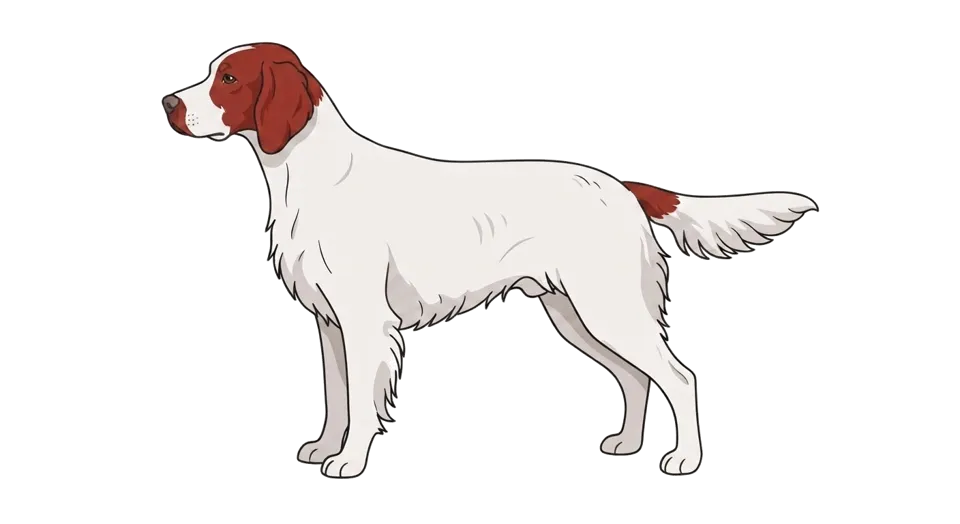
Red and white
Standard colour
The only accepted pattern, clearly patched rather than mostly white with red ticking.
Timeline
History & development
17th century
Original Irish setting type
Red and white dogs were the dominant setter type in Ireland before solid red became fashionable.
1800s
Decline in favour of solid red
Show breeders increasingly favoured the flashier all-red Irish Setter, pushing the red and white toward extinction.
early 1900s
Rescue by dedicated breeders
The Reverend Noble Huston's kennel in County Down kept a working line alive.
1944
Breed club formed
An Irish Red and White Setter Club was established to formalise the standard.
2009
AKC recognition
The breed gained full American Kennel Club recognition.
Reference
Breed standard summary
- body
- Deep chest, strong loin, well-balanced.
- coat
- Flat, fine, with moderate feathering.
- ears
- Set level with the eye, hanging close to the cheek.
- eyes
- Dark hazel to brown, intelligent expression.
- gait
- Driving, ground-covering, purposeful.
- head
- Well-defined stop, slightly domed skull.
- size
- Large
- tail
- Level with the back, tapering to a fine point.
- colour
- Red and white. Colours outside this list are seen but are not accepted by the kennel clubs.
- temperament
- Typical of the breed: strongest in energy, trainability, sociability. Nervousness or aggression are serious faults in the show ring and in the home.
- general appearance
- Athletic, strongly built setter, patched red and white.
Health
What to screen for
Green means little to worry about, amber means ask the breeder for test results, red means manage it actively.
Hip dysplasia
Screen for it
Ask for hip scores on both parents.
Canine leucocyte adhesion deficiency (CLAD)
Watch closely
A known inherited immune disorder in the breed; ask for DNA test results.
Hypothyroidism
Screen for it
Thyroid testing is worthwhile in adult dogs with coat or energy changes.
General information only — always speak to your vet about your own dog.
From real owners
Irish Red and White Setters in the PAWPOINT Pack
Irish Red and White Setters added by PawPoint members through their pet passports. Share yours to appear here.
Loading the wall…
Made for the Irish Red and White Setter
The book, plus hoodies, tees and mugs featuring the Irish Red and White Setter.